Summary
A global clinical study launched role-based training and reference content within ALEX, MTA’s learning management platform, to support clinical site staff across North America (NA), Europe, the Middle East, and Africa (EMEA) on multiple protocols. The deployment supported both in-person and remote learners to ensure high-quality consistency of training, delivered role-specific modules and catalogs, and provided detailed reporting for 1,104 learners.
Objectives
The objectives were to deliver role-based training and provide reference materials to clinical site teams across multiple regions and countries on multiple protocols, with some sites only participating in one, while others participating in all. Additionally, the objective was to offer flexible completion options that accommodated both in-person and remote learners and ensure regulatory acknowledgements were captured where required. The study team needed to monitor uptake and measure the effectiveness of reference materials and training content.
Solution
MTA offered a comprehensive solution – ALEX (A Learning Experience), MTA’s purpose-built learning management platform designed for life sciences professionals to navigate the demands of clinical research training. ALEX is focused on compliance and measurable outcomes that give study managers visibility into learner progress, completion rates, and performance. ALEX keeps content organized and audit-ready. Built for life sciences professionals, ALEX simplifies complex workflows so teams can stay compliant, confident, and productive across every study, protocol, and role – making it a robust solution for customers’ complex global clinical study needs.
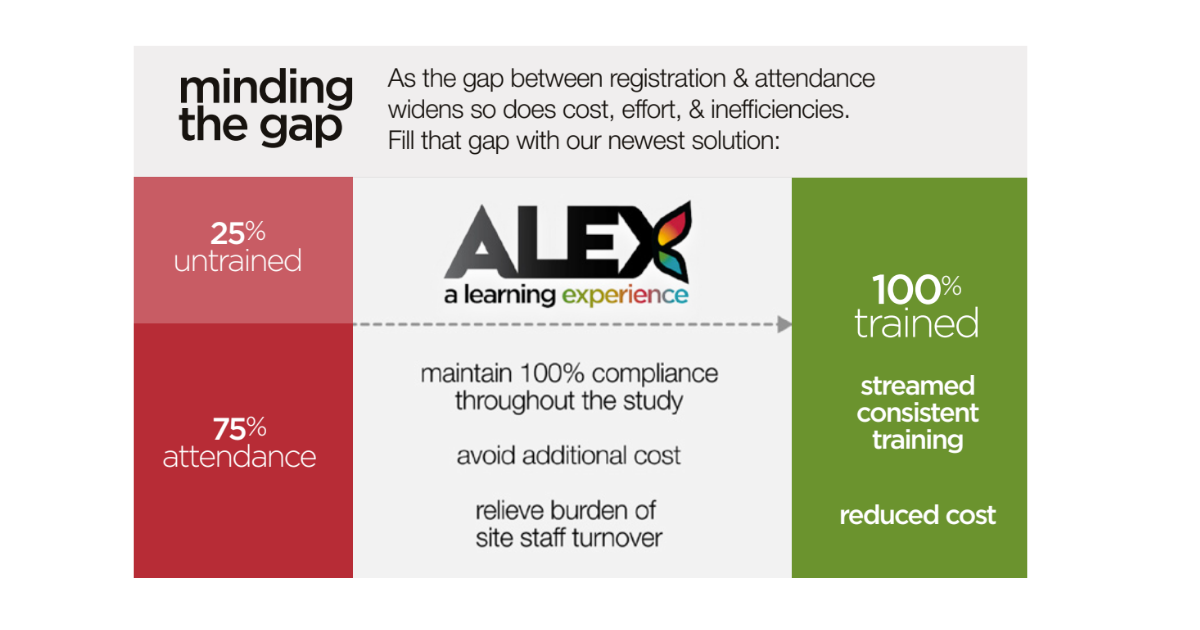
MTA’s ALEX learning management platform was launched in June 2025 for this customer’s complex global program and served 1,104 total learners. The platform included EMEA and North America content, with role‑based modules and catalogs assigned according to each user’s study protocol/s participation, role, and country. Reference materials and external links were available with access controls configured at the site, country, and role levels. The most recent protocol version had been posted to both the NA and EMEA sites.
For in-person learners, MTA recorded attendance using the platform’s in-person feature, so site staff who attended live sessions at the regional Investigator Meeting were seamlessly tracked. Those learners saw the catalog marked as completed, but still had access to the content for their reference at any time. For learners who participated remotely or were not able to attend in person, MTA assigned training through the system and required a mandatory “read and acknowledge” flow for modules and catalogs to be marked complete and certificates to be issued. These modules will also be available for new clinical site staff throughout the life of the study, relieving site burden and resulting in stronger training compliance.
On the reporting side, reporting was enabled so the study team could pull usage reports by site to view which materials were most used and helpful. The most recent protocol was posted to NA and EMEA — EMEA reached 55% completion within three months of posting, and NA reached 65% completion in the same period.
Outcomes
- Successful global roll-out on schedule with 1,104 learners onboarded.
- Flexible completion workflows accommodated both in-person and remote learners on multiple protocols.
- Early protocol adoption metrics indicate majority engagement in NA (65%) and substantial uptake in EMEA (55%) within three months.
- Reporting on usage gave the study team actionable insight into content support and site performance.
Feedback Summary from the Project Manager
Most importantly, MTA’s customer provided feedback regarding the ALEX experience:
The Project Manager (PM) noted that the planning and implementation of ALEX were smooth and well-coordinated, with prompt setup and responsive support following approval. The PM found the platform intuitive and user-friendly, with documents clearly organized within catalogs for straightforward navigation; the reporting tools were easy to use and offered valuable insights, including tracking which documented users’ downloads and the option to restrict access to Reference Files and External Links by country.
Additionally, the PM documented that ALEX added clear operational value to the study by centralizing oversight of site staff training compliance and simplifying document distribution to many users. Key benefits cited included:
- Centralized monitoring of training completion and compliance
- Convenient sharing and local storage/printing of reference materials
- Hosting system links in a single location to reduce URL searching
- Generating certificates that list completed training items to ensure audit-readiness
Conclusion
The ALEX deployment was successful at delivering training for multiple protocols to 1,104 learners across NA and EMEA, supporting both in‑person and remote completion, and strong early adoption with 65% completion in North America and 55% in EMEA. The platform was praised by the project manager for its intuitive design, responsive implementation support, centralized compliance oversight, and practical features.
For more information regarding ALEX (A Learning Experience), click here.


