Measuring the Impact of Your Face-to-Face Event Using Data

How Data Impacts Your Face-to-Face meetings

Measuring ROI at Face-to-Face Events

Our clients often pose the question to the Miller Tanner Associates (MTA) team, “How can we prove to our key stakeholders that it is worth the investment of time, money and resources required for face-to-face events, when the efficiency and ease of virtual events is powerful and persuasive?” 

The simple answer is data.

This year, MTA’s focus has been to show data that supports how an event has “moved the needle” and achieved its goals offering a huge ROI for our clients. By using both pre- and post-meeting surveys, we can show that the face-to-face event impacted the attendee in a tangible, meaningful way.

Always practicing what we preach, MTA experimented with this at our own Annual Global Workshop. Since event management is listed as one of the top 5 most stressful careers, one of our key goals for the week was to increase each team member’s focus on personal work-life balance. By ensuring that our team stays in balance, with a healthy dose of self-care, they are able to continue supporting our clients and events with the stamina that this industry requires.  We endeavored to prove that time spent at our Workshop practicing work-life balance skills actually changed our team’s intended actions after the event. 

Pre-Meeting Survey

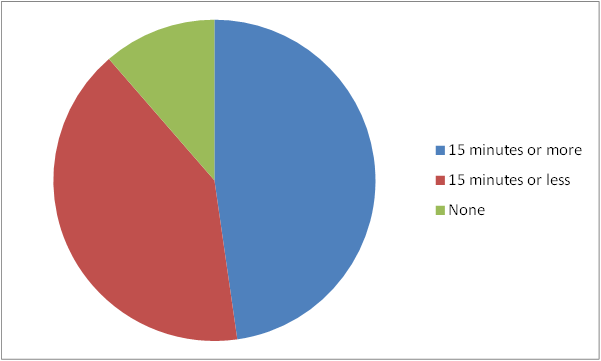
In our pre-meeting survey we asked, “How much time do you spend each day to ensure you have what you need to be productive and happy?” Here were the results:

Survey Results: How much time do you spend each day to ensure you have what you need to be productive and happy?

48% spent 15 minutes or more
41% spent 15 minutes or less
11% spent no time

Post-Meeting Survey

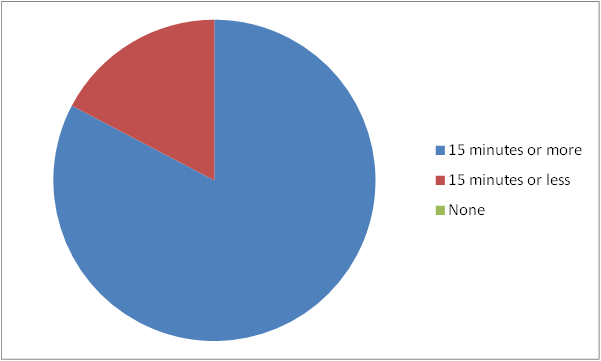
In the post-meeting survey we asked, “How much time each day do you think that you will spend in the future to ensure you have what you need to be productive and happy?” Here were the results:

Post-Meeting Survey Results: How much time do you spend each day to ensure you have what you need to be productive and happy?

83% intended to spend 15 minutes or more, an increase of 35%
17% intended to spend 15 minutes or less
0% intended to spend no time

We see these results as a huge victory!  We were able to prove that our time together significantly “moved the needle” and impacted the behavior of our attendees. Building off of this, we will collect data again next year to see if they were able to maintain this behavior.  Stay tuned for more details on how this focus impacts the brand loyalty of our team and the efficiency with which they work!

We have been working closely with many of our clients to help understand what their event goals are, design programs that support those intentions, and collect data to support the success of their endeavors; as a result, this allows them to prove ROI to their stakeholders for the investment of time, money and resources.

Are you ready to move the needle with us?

Investigator Meetings: Q & A with MTA

Investigator Meetings Questions & Answers from Miller Tanner Associates

Our Miller Tanner Associates (MTA) Global Sales Team comprised of Dawn Barnes, Director of Global Sales, along with Diana Reed, Key Accounts Manager, and Lauren Beegal, Senior Business Development Manager, share with us all the latest trends and tips for planning successful investigator meetings (IM).

Investigator Meetings: Q & A

What are some of the latest trends you are seeing with investigator meetings?

Dawn: Companies are branching out to have fewer traditional speaker PowerPoint presentations be replaced with more interactive sessions like panels for Q&A versus round-table working group discussions during investigator meetings.  While investigator meeting agenda lengths have been reduced over time, technology is now being more utilized to show real-time data and give immediate results through audience polling for content retention through content engagement platforms like ARS.

Diana: I think integrating technology into our events to enhance audience engagement is a hot topic with our clients at the moment; we are able to work within our own platforms and partner with various vendors to achieve maximum participation in our events.

Lauren: The current trends are use of technology not only to plan a more efficient, paperless meeting, but also incorporate the latest technology advances to engage attendees through live-result polling, gamification, and enhanced presentations.  We recently incorporated a hologram speaker at one of our meetings, which immediately gained the attention of everyone in the room.

What are the benefits of a face-to-face (F2F) versus a virtual investigator meeting?

Dawn: While cost is a factor that all clients consider upfront when planning an event, we believe there is no better money spent than having that personal interaction and face-to-face time with their audience.  Peer-to-peer sharing continues to help guide the development process and ensure patient enrollment success. However, there is a time and a place for a virtual event within the overall development planning cycle.  For instance, if there is a protocol amendment, clients don’t have to spend unplanned funds having extra monitoring visits per site when they can reinforce the new updates or changes all at once to all sites simultaneously through virtual means.

Diana: Time spent at face-to-face meetings are crucial not only for the meeting sponsor but it is also time for investigators to come together and network within their industry. They are able to collaborate more as a group and collectively discuss important topics and ideas around the clinical study.

Lauren: Often the benefits of a face-to-face meeting are the intangibles that are hard to quantify.  The ability to connect while sharing a meal, discussion, coffee break, or crossing paths in the hallway are instrumental in developing and nurturing relationships.

What type of event do healthcare providers (HCPs) prefer?

Dawn: The U.S. and European Union (EU) are much more open to virtual events as it has become more of a common occurrence.  However, in regions like South America or Asia Pacific, they still prefer face-to-face culturally. In our experience, U.S. sites prefer events taking place towards the end of the work week or even over a weekend versus while in the EU they prefer during the work week.  This is based upon our global experience as well as attendee direct feedback from our post-event surveys completed after every event.

Diana: I believe that HCPs prefer to attend an investigator meeting face-to-face, but appreciate an agenda that is applicable to their involvement in the study; the less time out of the office, the better. Providing online training/presentations ahead of the meeting will save on time at the investigator meeting and, therefore, HCPs will be more willing to attend.

Lauren: The majority of the HCPs recognize and value a face-to-face meeting; they are more appreciative when the meeting is thoughtfully planned and executed in order to justify their time and attendance while being away from their patients.

What are the biggest challenges when planning an investigator meeting?

Dawn: One challenge is having advanced lead-time for effective planning of the actual event – timelines continue to be reduced to bring an event to life.  This challenges us given the amount of upfront activities required to get a budget agreed, locate the right venue, secure the hotel contract, negotiate the best deal for our clients to get invites launched all the while ensuring compliance for healthcare provider spend reporting and their respective country codes of conduct.

Diana: The time leading up to the meeting is a challenge. We have less and less time to plan and get investigators to the meeting.

Lauren: There can be hesitancy to enhance a meeting to ensure it is as efficient, effective, and engaging as possible.  This is particularly true when the investigator meeting is part of a series of meetings.  Although most companies tend to have a similar meeting objective to engage the attendees, the tendency is to repeat what has been done previously instead of utilizing new approaches due to perceived cost or time restraints.

What are some key strategies for launching a successful investigator meeting?

Dawn: Understanding our client’s vision for their event is key in order to have an effective strategy to implement and execute within the available timelines.  Knowing our client’s event must-haves versus nice-to-haves based upon partnership experience allows us to “repeat” their prior events for consistency and approach to yield success.

Diana: A lot of our clients want to invest in technology to enhance the meeting experience, but they do not know how to use it. MTA will partner with their clients on working through their agenda, presentations, and meeting schedule to incorporate this investment.

Lauren: In this fast-paced industry, it is important to take a step back and understand the big-picture goals for the meeting.  Once goals are identified, my strategy is to ensure that decisions being made throughout the planning process achieve those goals.

How much time is needed to plan an investigator meeting?

Dawn: We recommend 10-12 weeks of planning from invitation launch to event date.  Time sometimes is a challenge for our clients though so we try to streamline the planning process upfront wherever we can to accommodate reduced timelines; however, advanced notice to sites to block dates is key when a timeline is less than 10 weeks in order to ensure high attendance ratios for their event.

Diana: I think 3 months is ideal, but 10 weeks is sufficient.

What’s the first step?

Dawn: Once an investigator meeting has been awarded to MTA, our first step is holding a joint Kick-Off Meeting which includes cross-functional representation internally like Sales, Project Development, Global Events, and Compliance to discuss the following:

        • Overall goals and objectives of client/event
        • Defining success with client for their investigator meeting
        • Understanding expectations for all parties/roles involved
        • Reviewing timeline of activities that lead up to the event date – client versus MTA
        • Outlining the agenda and its technical requirements inside the room
        • Addressing logistics questions
        • Documenting agreements and next steps for weekly planning calls

If you have an upcoming investigator meeting on the horizon, let our team of expert event planners assist with your planning details. 

Get Help Planning Your Next Investigator Meeting

Contact Us
8 Work-Life Balance Activities for Your Events

 Why Work-life Balance is Important

The U.S. ranks in the bottom 20 percent for work-life balance among the 38 countries surveyed in a report compiled by Family Living Today and Now Sourcing On average, people spend nine and a half hours a day on “personal care” and that includes everything from sleep to showering. Nine and a half hours a day is not much when you consider that eight hours of sleep is optimal.

Because of technology, it has becoming increasingly difficult to separate work from personal life making it a challenge for employees to achieve a healthy work-life balance.  Not only is this balance necessary for mental health and personal growth, but it also creates a more desirable working environment and happier employees. “Put simply, if your people don’t view work as a chore, then they will work harder, make fewer mistakes and are more likely to become advocates for your brand,” according to the Happiness Index.

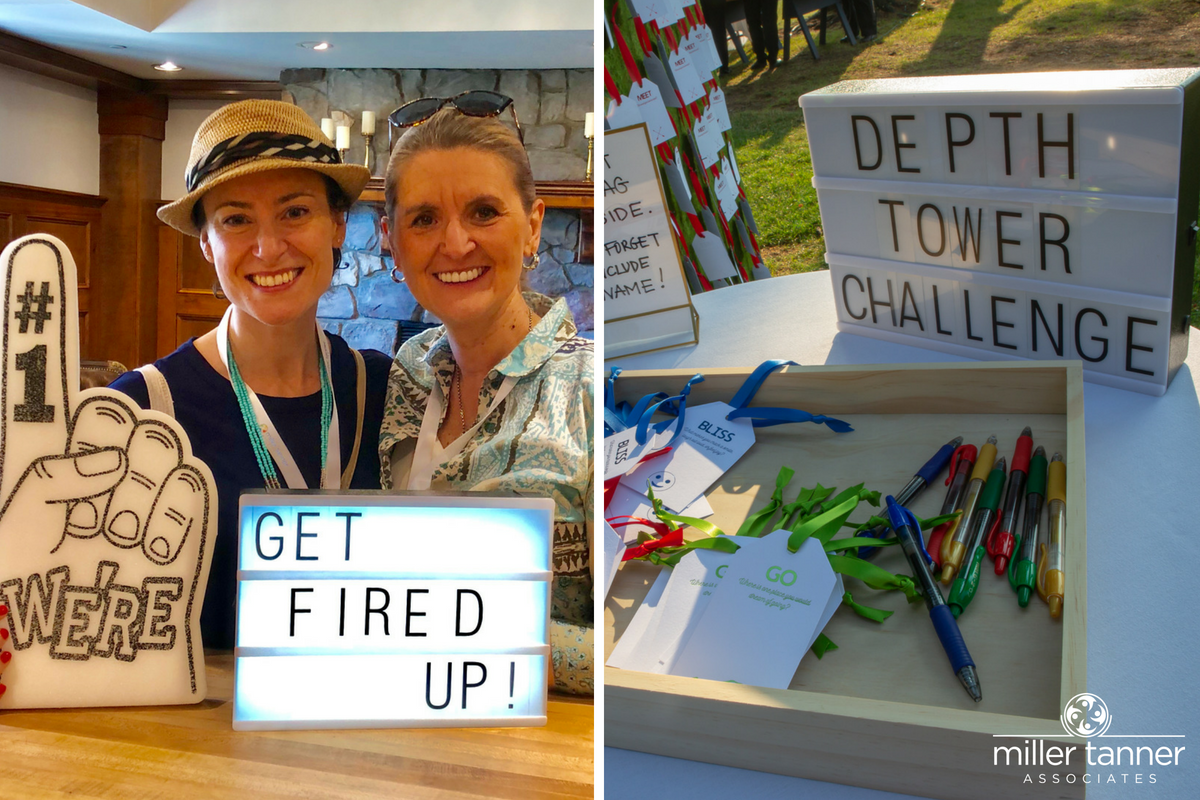
Events and meetings are a prime opportunity to introduce and practice work-life balance principles within your team. Work-life balance was one of the focused themes of our MTA Workshop this year. Although we were on site together for intensive training, we also sought to put into practice these important concepts.

Continue reading “8 Work-Life Balance Activities for Your Events”

How to Plan a Socially-Responsible Green Event

How to Design a More Socially-Conscious, Environmentally-Friendly Event

Here are four ways that you can plan a more intentional event and how our team accomplished it at one of our annual MTA Workshops:

1. Give-Back Programs

Why not bring your teams together for a combined team-building activity while supporting a worthy cause? Double whammy! Find a local or global philanthropic organization to support or contribute volunteer time to a community service project for an on-site or off-site CSR activity. You can also weave CSR throughout your event by sourcing gift and decoration products from socially-responsible vendors.

giveback

Support a local organization

How we did it:

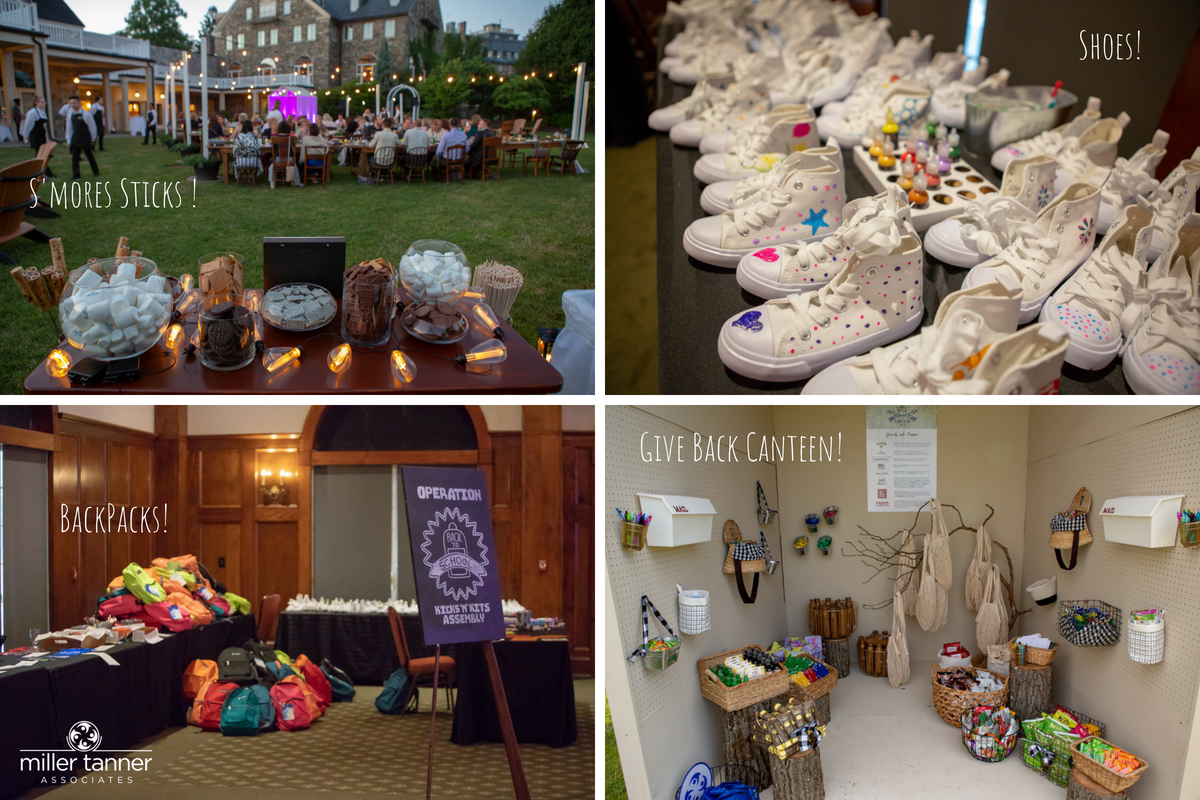
Because our team met in Pennsylvania, we wanted to support an organization locally so we chose a project to support the Girls and Boys Club of Northern PA. Our team decorated shoes for 3rd, 4th and 5th grade at-risk students and stuffed 100 backpacks filled with back-to-school supplies for students that excelled in their “Power Hour” after-school program.

Integrate CSR into your on-site decorations and gift products 

How we did it:

Since a lot of our activities took place in the great outdoors, we sourced citronella candles from United by Blue. In doing so, MTA removed 82 pounds of ocean waste with our purchases! Our Workshop wouldn’t have been complete without fireside chats and s’mores around the fire pit. We sourced hand-crafted Kabbage and Hugs s’more sticks, made from beetle kill wood, reused and repurposed from forests in the Rocky Mountains. Throughout our event we incorporated beautiful multi-use blankets by the Riviera Towel Company, a Santa Barbara company that donates funding to ocean clean up efforts.

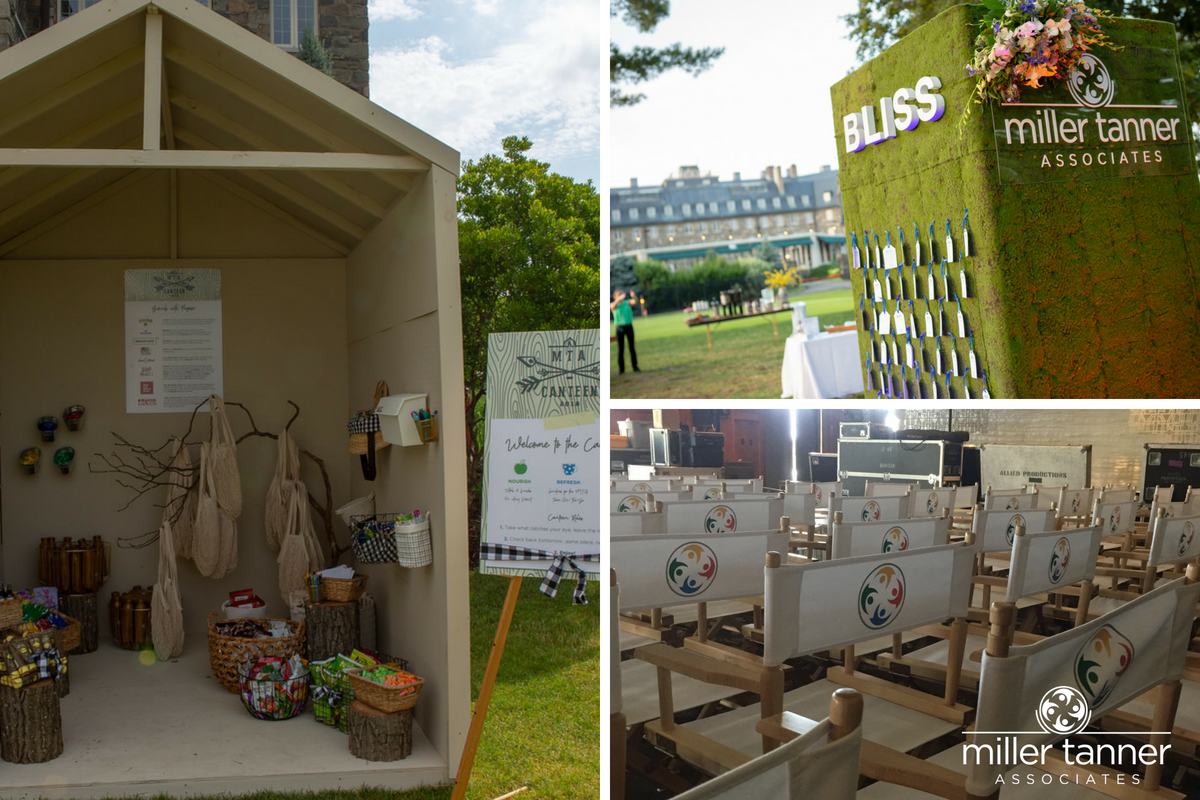
Each day our Give-Back Canteen, a decorative outdoor fixture, was fully stocked with a variety of products from brands with missions that support reducing environmental waste, providing meals to the hungry, providing for the homeless, and/or donating proceeds toward worthy causes. Some of the brands included Annie’s, Bombas (72 pairs of anti-microbial socks provided to the homeless), Brandless (66 meals provided to the hungry), Kind, Love with Food, Project 7, This Bar Saves Lives (72 nutrient packets provided to malnourished children) and more! At the conclusion of the event, all unused products were donated to the Boys and Girls Club.

2. Source and Support Locally

Choose local. By sourcing locally from the location of the event, you’ll minimize shipping and reduce your carbon footprint. This will not only make a big impact on the environment but also on your event budget. Save money, save the environment. Make it a win-win!

Support local businesses and vendors 

How we did it:

Our team of planners intentionally chose socially-responsible vendors from which to purchase products and services. We also used locally-owned restaurants and food service providers for our team dinners. And many locally-made gifts were purchased from surrounding area shops.

Support local artists and contractors

How we did it:

To add a whimsical flair to our event set, we had a few structures including a “Depth Tower” and a Give-Back Canteen built on site using local contractors. We also hired local artists to produce signage.

3. Reduce and Recycle Waste

Cut out the excess. Plan your event with the intent of producing less waste. You can do this countless ways starting with going paperless and getting rid of paper agendas and programs. Also, consider recycling at your event! This can be accomplished by taking simple measures such as placing recycle bins throughout the venue, and using recyclable packaging and bio-degradable items.

signs

Go paperless

How we did it:

Thanks to our Mobile Attendee Website, our event was paperless! All agendas and itineraries were easily accessible with the click of a button. We also used popular marquee displays allowing us to change out messaging daily while easily reducing the waste of additional signage.

Reduce use of plastics and use recyclable goods

How we did it:

Our attendees were gifted refillable stainless-steel water bottles that keep beverages cold all day, allowing attendees to fill up their water bottles when needed. We provided various flavor add-ins for their choosing. This omitted the need for plastic water bottles on site at the event. We ditched excess packaging and opted for ECOHIP reusable grocery bags to shop the Give-Back Canteen. Our branded welcome boxes were 100% recyclable as were our paper straws, in an effort to minimize plastic pollution.

Reduce carbon footprint

How we did it:

Instead of the typical one-car-per-person travel, we doubled up on transfers and grouped attendees together to offer the experience of traveling as part of the meeting. Yet again reducing our carbon footprint.

4. Repurpose

So many aspects of your event can be repurposed; it just takes a little extra planning. Look for ways in which you might donate items or dismantle structures to reuse in a new, creative way.

Canteen, tower, chairs

Donate

How we did it:

The wooden Give-Back Canteen structure will soon be reincarnated; in its next life, it will serve as a playhouse for happy children at a local community park. All remaining canteen items, such as individually-wrapped snacks, were donated to the local Boys and Girls Club.

The white directors chairs that were used for event seating, were donated to two local theaters along with the tables to be used for stage furniture in future productions.

Reinvent

How we did it:

As part of our event set, we created a “Depth Tower” which not only served as a decorative structure but was also used as a message board and a way for our team to engage with one another. The tower will be dismantled and repurposed to create handmade gift boxes filled with gifts to be donated to families in need at Christmas.

It doesn’t take an environmental scientist to determine impactful ways of creating a greener event. It just takes some great preplanning and maybe some paper straws to get you started.

Our team can help plan a socially-responsible event just like they did with ours. Reach out to us to learn how you can make a difference at your next event.